
The Pancaratra Agamas: A Comprehensive Overview

Numerous Pancaratra Agama PDFs are becoming increasingly available online, facilitating scholarly research and wider accessibility to these foundational Vaishnava texts.
Digital archives and dedicated websites now host digitized versions of key Samhitas and Tantras, offering invaluable resources for students and practitioners.
However, navigating this growing collection requires discernment, as the quality and accuracy of transcriptions can vary significantly across different sources.
The Pancaratra tradition represents a significant stream within Hinduism, deeply rooted in the devotion to Vishnu and characterized by a wealth of Agama texts, intricate rituals, and a unique philosophical outlook. It’s a Vaishnava Tantric system, offering a comprehensive path to liberation through worship and spiritual practice.
Historically, the tradition traces its origins back to ancient India, with some scholars suggesting roots as early as the 3rd century BCE, centered around the worship of Narayana. The name “Pancaratra” itself signifies “five nights,” potentially referencing a foundational revelation or a specific cosmological understanding.
Central to the Pancaratra is the concept of Narayana as the supreme being, the source of all creation and the ultimate reality. This tradition emphasizes a direct relationship with the divine, achievable through dedicated worship, mantra recitation, and the observance of prescribed rituals. The increasing availability of Pancaratra Agama PDFs is aiding in the study and preservation of this ancient and profound tradition.
These texts provide detailed guidance on temple construction, iconography, and the performance of elaborate pujas, offering a holistic framework for spiritual life.
Historical Context and Origins
Tracing the historical origins of the Pancaratra Agamas is a complex undertaking, with scholarly debate surrounding their precise dating and development. Evidence suggests roots extending back to the late 3rd century BCE, emerging around the veneration of Narayana-Vishnu within early Vaishnavism.
The tradition asserts its own divine origin, claiming direct transmission from Narayana himself, as stated in Pancaratra texts: “Pañcarātrasya kṛtsnasya vaktā nārāyaṇaḥ svayam.” This emphasizes the sacred and authoritative nature of the teachings.
However, the earliest extant texts date to the Gupta period (4th-6th centuries CE), indicating a significant period of oral transmission and development prior to written codification. The increasing accessibility of Pancaratra Agama PDFs allows researchers to analyze these texts, shedding light on their evolution.
Furthermore, the Pancaratra tradition often claims Vedic origins, seeking to legitimize itself within the broader Hindu framework, though its distinct characteristics set it apart as a unique and influential school of thought.
The Relationship to the Vedas
The Pancaratra Agamas navigate a complex relationship with the Vedic tradition, often asserting a connection while simultaneously presenting distinct theological and ritual practices. Like other Hindu sectarian traditions, Pancaratra seeks to establish legitimacy by tracing its origins back to the Vedas, the foundational scriptures of Hinduism.
However, the Agamas are not simply expansions of Vedic thought; they introduce novel concepts and practices, particularly concerning the worship of Narayana and the elaborate cosmology of the four Vyuhas. The availability of Pancaratra Agama PDFs facilitates comparative study, revealing both continuities and divergences.
While acknowledging the authority of the Vedas, Pancaratra posits the Agamas as a supplementary revelation, suited to the Kali Yuga, the current age characterized by diminished spiritual capacity. This allows for more accessible and personalized devotional practices.
Ultimately, the relationship is one of selective appropriation and reinterpretation, with the Agamas adapting Vedic elements to serve their own unique theological agenda.
Narayana as the Supreme Being
Central to Pancaratra theology is the assertion of Narayana (Vishnu) as the ultimate reality, the source and sustainer of the universe. This differs from some Vedic traditions which emphasize a more abstract Brahman. The Pancaratra Agamas, readily accessible through numerous PDFs, detail Narayana’s multifaceted nature and supreme sovereignty.
These texts portray Narayana not merely as a deity among many, but as the transcendent, all-pervading principle underlying all existence. His divine form, qualities, and activities are extensively elaborated upon, forming the core of Pancaratra devotion.
The Agamas emphasize Narayana’s inherent power (shakti) and his capacity to manifest in various forms, including avatars, to interact with the created world. Studying these PDFs reveals a sophisticated system of cosmology and ontology centered on Narayana.
Ultimately, the entire universe is considered an emanation from Narayana, and the goal of spiritual life is to realize one’s inherent connection to him.
The Role of Narayana in Pancaratra Theology
Within Pancaratra theology, as detailed in accessible PDFs of the Agamas, Narayana’s role extends beyond creator and preserver; he is the dynamic principle of all existence. He isn’t a distant, uninvolved deity, but actively engaged in the cosmic play (lila) of creation, maintenance, and dissolution.
The Agamas emphasize Narayana’s fivefold manifestation – the Panca-bhuta – representing his pervasive presence in the material world. These texts, now widely available as PDFs, outline intricate systems of worship designed to connect devotees with this divine energy.
Furthermore, Narayana’s role is intrinsically linked to the concept of the four vyuhas – Samkarshana, Pradyumna, Aniruddha, and Vasudeva – representing different aspects of his divine power and activity.
Studying these Agamas through available PDFs reveals that liberation (moksha) is achieved through complete surrender and devotion to Narayana, recognizing him as the ultimate reality.

Core Texts and Literature
Digitized Pancaratra Agama PDFs reveal a vast corpus of over 200 texts, including Samhitas, Tantras, and supplementary works, forming a complex literary tradition.
These PDFs offer access to foundational scriptures, enabling deeper exploration of Pancaratra’s philosophical and ritual systems.
Overview of Pancaratra Agamas
The Pancaratra Agamas, accessible increasingly through PDF formats, represent a significant body of Vaishnava religious literature. These texts, numbering over 200, are not monolithic but comprise diverse Samhitas, Tantras, and related works, each offering unique perspectives on devotion to Narayana-Vishnu.
PDF versions allow researchers and practitioners to study these ancient scriptures, revealing intricate details about cosmology, theology, ritual practices, and temple construction. The Agamas are considered revealed texts, passed down through a guru-shishya parampara, and their digital availability broadens access to this knowledge.
However, the proliferation of Pancaratra Agama PDFs also presents challenges. Variations in transcription quality, incomplete translations, and differing interpretations require careful discernment. Scholars emphasize the importance of consulting multiple sources and relying on established academic editions when studying these complex texts. The digital format facilitates comparative analysis, aiding in a more nuanced understanding of the Pancaratra tradition.
Key Texts: The Samhitas
The Samhitas are foundational texts within the Pancaratra Agamas, often available in PDF format for scholarly study. These are considered the earliest and most authoritative components of the tradition, laying out core doctrines and practices related to Narayana worship.

Key Samhitas, such as the Jayakhya Samhita, the Ahobilashamhita, and the Paramasamhita, detail intricate rituals, mantra systems, and philosophical concepts. Digitized PDFs allow for detailed textual analysis, enabling researchers to trace the evolution of Pancaratra thought. Access to these PDFs is crucial for understanding the nuances of Vaishnava theology.
However, navigating these texts requires caution. PDF versions may vary in quality, and translations are often incomplete or subject to interpretation. Scholars recommend comparing multiple editions and consulting commentaries to gain a comprehensive understanding of the Samhitas’ profound teachings. The availability of these texts in PDF format is revolutionizing the study of Pancaratra.

Important Tantras within the Pancaratra
Beyond the Samhitas, numerous Tantras comprise the vast literature of the Pancaratra Agamas, with increasing numbers accessible as PDFs. These texts expand upon the foundational principles, detailing specific deities, rituals, and yogic practices. The Ishvara Samhita and the Shanti Parva are particularly significant, offering detailed guidance on temple construction and iconographic principles.
PDF versions of these Tantras facilitate comparative study, allowing researchers to identify common themes and variations across different lineages. Access to these digital resources is invaluable for understanding the diverse expressions of Pancaratra devotion. However, the quality of PDF transcriptions can vary, necessitating careful evaluation.
Scholars emphasize the importance of consulting multiple sources and relying on established translations when working with these complex texts. The proliferation of Pancaratra Agama PDFs is democratizing access to this rich tradition, fostering deeper understanding and appreciation.
The Number and Classification of Pancaratra Texts
Estimates suggest the Pancaratra tradition encompasses over 200 distinct Agamas, though the exact number remains debated due to variations in classification and textual transmission. Many are now available as PDFs, presenting both opportunities and challenges for researchers. These texts are broadly categorized into three main groups: the Samhitas, the Tantras, and the Vidhyas.
PDF access allows for comparative analysis of these classifications, revealing nuanced differences in emphasis and approach. The Samhitas, foundational texts, are often prioritized in digital archiving efforts. However, the Tantras, detailing specific rituals and practices, are also increasingly available.
Navigating this extensive collection requires familiarity with traditional categorization schemes. The increasing availability of Pancaratra Agama PDFs is revolutionizing the study of this complex tradition, though critical evaluation of source material remains essential.

Philosophical Concepts
PDF versions of Pancaratra texts reveal core doctrines like the Four Vyuhas and the concept of Lila, offering insights into complex theological frameworks.
Scholarly analysis of these digitized Agamas illuminates the nuanced philosophical underpinnings of Vaishnava thought and practice.
The Four Vyuhas: A Central Doctrine
The concept of the Four Vyuhas, a unique contribution of the Pancaratra Agamas to Hindu philosophical literature, is extensively detailed within available PDF texts.
These Vyuhas – Vasudeva, Samkarshana, Pradyumna, and Aniruddha – represent emanations or manifestations of the Supreme Being, Narayana, and are crucial for understanding Pancaratra cosmology.
Digitized versions of texts like the Jayakhya Samhita and the Ahirbudhnya Samhita provide detailed explanations of each Vyuha’s attributes, functions, and relationships to one another.
Scholars utilizing these PDFs highlight that ‘Vyuha’ signifies a strategic arrangement or emanation, not merely separate entities, but integrated aspects of the divine.
The PDFs demonstrate how the Vyuhas are interconnected, forming a complex system that explains the creation, maintenance, and dissolution of the universe.
Furthermore, the study of these texts reveals that the Vyuhas are also linked to specific deities and avatars, enriching the understanding of Vaishnava iconography and worship.
Access to these PDFs allows for a deeper exploration of this central doctrine, revealing its profound impact on Vaishnava theology and practice.
Understanding Vyuha – Its Meaning and Significance
Pancaratra Agama PDFs meticulously explain ‘Vyuha,’ translating to a strategic arrangement or manifestation, not individual deities but integrated aspects of Narayana.
These texts, such as the Isvara Samhita available in digital format, emphasize Vyuha as a divine ‘plan’ or ‘formation’ through which the Supreme Being interacts with creation.
Scholarly analysis of these PDFs reveals that Vyuha isn’t a simple emanation but a dynamic process, a deliberate unfolding of divine energy for cosmic purposes.
The significance lies in understanding that the four Vyuhas aren’t separate entities but represent different facets of the same ultimate reality, Narayana.
PDF versions of commentaries clarify that Vyuha facilitates both transcendence and immanence, allowing the divine to be both beyond and within the universe.
Studying these texts demonstrates how Vyuha provides a framework for comprehending the complex relationship between the Supreme Being and the manifested world.
Access to these digital resources unlocks a nuanced understanding of this core Pancaratra concept, vital for grasping its theological depth and philosophical implications.
The Concept of Avatars in Pancaratra
Pancaratra Agama PDFs detail a unique perspective on avatars, differing from more commonly known Puranic accounts; they aren’t merely descents but strategic manifestations.
Digital texts, like the Padma Tantra, explain avatars as deliberate ‘expansions’ of Narayana’s energy, tailored to specific cosmic needs and upholding dharma.
Scholars analyzing these PDFs note that Pancaratra views avatars as integral to the Vyuha system, arising from and connected to the four primary manifestations.
The concept extends beyond major avatars like Rama and Krishna, encompassing numerous lesser-known forms, each serving a precise divine purpose.
PDF commentaries clarify that avatars aren’t limitations of the divine but demonstrations of its infinite capacity to engage with creation.
These texts also discuss ‘avatars from avatars,’ highlighting a hierarchical structure and the continuous unfolding of divine manifestations.
Accessing these digital resources provides a deeper understanding of Pancaratra’s sophisticated avatarology, enriching the broader Vaishnava tradition.
The Role of Lila (Divine Play)
Pancaratra Agama PDFs extensively explore the concept of lila, or divine play, as the fundamental principle governing creation and the Lord’s interactions with the universe.
Digital versions of texts like the Jayakhya Samhita reveal lila isn’t arbitrary but a purposeful, joyous expression of Narayana’s inherent nature and power.
Scholars studying these PDFs emphasize that lila encompasses both the creation and dissolution of worlds, experienced as a continuous, blissful activity.
The concept explains seemingly paradoxical events, framing them as facets of the divine play, beyond human comprehension yet ultimately benevolent.
PDF commentaries demonstrate how lila manifests in avatars, rituals, and even the experiences of devotees, all part of the cosmic drama.
These texts highlight that recognizing lila fosters detachment and surrender, allowing one to participate in the divine joy rather than seeking control.
Accessing these digital resources offers a nuanced understanding of lila, central to Pancaratra’s worldview and devotional practices.

Rituals and Practices
Pancaratra Agama PDFs detail elaborate puja, mantra, and yantra practices, alongside temple construction guidelines (Silpa Agamas), for dedicated worship.
These digitized texts provide precise instructions for initiation (diksha) and ritual performance, crucial for authentic practice.
Pancaratra Puja: Worship Practices
Pancaratra Agama PDFs meticulously outline the complex procedures for puja, or worship, centered on Narayana. These texts detail the five daily worships – kala-puja – performed at specific times, emphasizing devotion and ritual precision.
Digitized versions of the Agamas reveal the importance of mantras, sacred sounds, and yantras, geometric diagrams, as essential tools for invoking divine energy and establishing a connection with the deity.
The PDFs illustrate the preparation of the worship space, the arrangement of offerings, and the specific mantras to be recited during each stage of the puja.
Furthermore, they describe the role of the worshiper, emphasizing purity of mind and body, and the importance of a qualified guru for proper guidance. The texts also cover the consecration of images and the performance of homa (fire sacrifice) as integral parts of the worship process.
Access to these PDFs allows practitioners to understand the philosophical underpinnings and practical applications of Pancaratra worship, fostering a deeper connection with Vishnu and his divine manifestations.
The Importance of Mantras and Yantras
Pancaratra Agama PDFs extensively detail the profound significance of mantras and yantras within the tradition’s spiritual framework; These texts reveal that mantras are not merely sounds, but potent vibrational energies capable of invoking specific deities and achieving desired outcomes.
Digitized versions of the Agamas showcase a vast repertoire of mantras associated with Narayana and his various forms, along with precise instructions for their correct pronunciation and application.
Similarly, yantras, geometric representations of cosmic energies, are presented as visual aids for meditation and worship, serving as focal points for concentration and divine connection.
The PDFs illustrate the construction and use of specific yantras, explaining their symbolic meanings and the corresponding mantras to be recited during their contemplation.
Access to these resources enables practitioners to harness the power of mantras and yantras, deepening their spiritual practice and accelerating their journey towards liberation.
Initiation (Diksha) in the Pancaratra Tradition
Pancaratra Agama PDFs meticulously outline the elaborate procedures for Diksha, or initiation, a crucial rite of passage within the tradition. These texts emphasize that initiation isn’t merely a ceremony, but a transformative process bestowing divine grace and enabling access to advanced spiritual practices.
Digitized versions of the Agamas detail various levels of initiation, each with specific prerequisites, mantras, and rituals tailored to the aspirant’s capacity and devotion.
The PDFs reveal that a qualified guru, possessing deep knowledge of the Agamas, is essential for administering Diksha correctly, ensuring the transmission of spiritual energy and safeguarding the initiate.
Detailed instructions regarding the preparation of the initiate, the selection of auspicious times, and the performance of elaborate pujas are readily available within these texts.
Access to these resources provides valuable insights into the profound significance of Diksha and its role in the practitioner’s spiritual evolution.
Temple Construction and Iconography (Silpa Agamas)
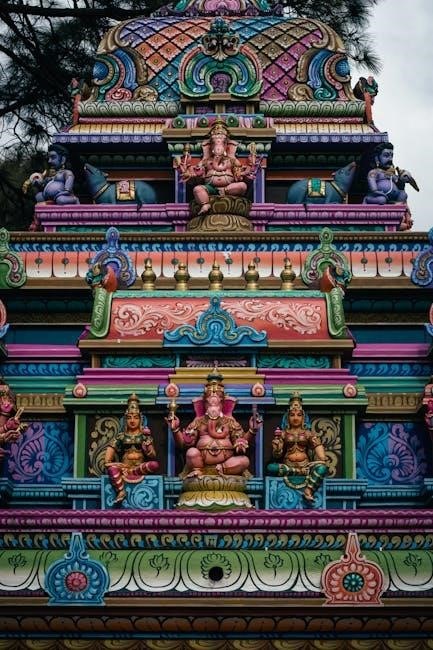
Pancaratra Agama PDFs, particularly the Silpa Agamas, provide exhaustive guidelines for temple architecture, sculpture, and iconography, deeply influencing Vaishnava temple design. These digital texts detail precise measurements, materials, and symbolic representations crucial for constructing sacred spaces.
The PDFs reveal intricate rules governing the layout of temples, the placement of deities, and the proportions of various architectural elements, all aligned with cosmological principles.
Detailed instructions on crafting images of Narayana and his various forms, including specific postures, gestures (mudras), and attributes, are readily accessible.
These texts emphasize the importance of adhering to prescribed iconographic standards to ensure the deity’s presence and efficacy within the temple.
Access to these digitized Silpa Agamas offers invaluable resources for architects, sculptors, and devotees seeking to understand and replicate traditional Vaishnava temple art.

Vaishnavism and Pancaratra
Pancaratra Agama PDFs demonstrate this tradition’s foundational role in shaping Vaishnava theology, rituals, and devotional practices, influencing the development of Bhakti Yoga.
Pancaratra as Foundational to Vaishnavism
The accessibility of Pancaratra Agama PDFs has dramatically underscored the tradition’s pivotal role as a cornerstone of Vaishnavism, revealing its profound influence on the faith’s theological underpinnings and ritualistic practices. These digitized texts demonstrate that Vaishnava traditions, as they evolved, heavily drew upon the doctrines and methodologies detailed within the Pancaratra corpus.
Scholarly analysis of these PDFs reveals that concepts central to Vaishnavism – such as the supremacy of Narayana, the doctrine of the four Vyuhas, and the importance of bhakti – are extensively elaborated upon in the Agamas long before their widespread adoption in later Vaishnava schools. The availability of these texts allows researchers to trace the historical development of Vaishnava thought, pinpointing the precise origins of key tenets.
Furthermore, the PDFs showcase the practical application of Pancaratra principles in temple construction, iconography, and worship procedures, solidifying its impact on the lived religious experience of Vaishnavas. The detailed instructions within the Silpa Agamas, now readily available, demonstrate the tradition’s comprehensive approach to sacred architecture and devotional expression.
Influence on Bhakti Yoga
The increasing availability of Pancaratra Agama PDFs illuminates the tradition’s significant, yet often understated, influence on the development of Bhakti Yoga within Vaishnavism. These texts demonstrate that the emphasis on loving devotion, central to Bhakti, wasn’t a later innovation, but rather deeply rooted in Pancaratra theology and practice.
Analysis of the digitized Agamas reveals detailed instructions on cultivating a personal relationship with Narayana through mantra repetition, meditative practices, and ritual worship – all hallmarks of Bhakti Yoga. The Agamas emphasize the importance of bhava (emotional attitude) and rasa (aesthetic experience) in devotional service, concepts later elaborated upon by Bhakti schools.
Moreover, the PDFs showcase the Pancaratra emphasis on grace (anugraha) and the devotee’s surrender to the divine, fostering an intimate connection with the deity. This focus on divine grace, readily accessible through the study of these texts, profoundly shaped the trajectory of Bhakti movements, influencing figures and schools across the Vaishnava spectrum.

The Development of Vaishnava Theology
The proliferation of Pancaratra Agama PDFs provides unprecedented access to the foundational texts that shaped Vaishnava theology. These digitized resources demonstrate that core doctrines, previously attributed to later schools, originated within the Pancaratra tradition centuries earlier.
Examination of these PDFs reveals the systematic development of concepts like Narayana as the supreme Brahman, the doctrine of the four Vyuhas, and the intricate cosmology underpinning Vaishnava worldviews. The Agamas articulate a sophisticated metaphysical framework, establishing Vishnu-Narayana as the source of all existence and the ultimate reality.
Furthermore, the accessibility of these texts clarifies how Pancaratra influenced the articulation of Vaishnava ethics, ritual practices, and the understanding of liberation (moksha). The PDFs showcase a cohesive theological system, providing a historical context for understanding the evolution of diverse Vaishnava schools and their interpretations of divine reality.
Modern Study and Accessibility
Digitized Pancaratra Agama PDFs are increasingly available, yet challenges remain in translation and interpretation due to textual complexities and varied scholarly approaches.
Ongoing research utilizes these resources, fostering a deeper understanding of this influential tradition and its enduring relevance in contemporary Hinduism.
Availability of Pancaratra Agama PDFs
The digital landscape has dramatically altered access to the Pancaratra Agamas, with a growing number of texts now available in PDF format. Previously confined to manuscripts and limited scholarly circles, these foundational Vaishnava scriptures are becoming increasingly accessible to researchers, practitioners, and those simply curious about this rich tradition.
Several online archives and dedicated websites specialize in hosting digitized versions of key Samhitas, Tantras, and related commentaries. These resources represent a significant boon for those seeking to study the Pancaratra system in detail. However, it’s crucial to exercise caution when utilizing these digital resources.
The quality of these PDFs can vary considerably, with some originating from meticulous transcriptions and others from less reliable sources. Variations in scanning quality, optical character recognition (OCR) accuracy, and editorial oversight can impact the usability and trustworthiness of the texts. Furthermore, copyright considerations and the provenance of the manuscripts should be carefully evaluated.
Despite these caveats, the proliferation of Pancaratra Agama PDFs represents a pivotal moment in the study and preservation of this important Hindu tradition, fostering wider engagement and scholarly inquiry.
Challenges in Translating and Interpreting Texts
Despite the increasing availability of Pancaratra Agama PDFs, significant challenges remain in accurately translating and interpreting these complex texts. The highly technical nature of the language, replete with specialized terminology and symbolic imagery, presents a formidable obstacle for even seasoned scholars.
Many Pancaratra texts employ a unique blend of Sanskrit, Prakrit dialects, and esoteric codes, demanding a deep understanding of both linguistic nuances and the broader philosophical context. Furthermore, the texts often assume a pre-existing familiarity with Tantric practices and Vaishnava theology, making them inaccessible to those without specialized training.
The inherent ambiguity of symbolic language and the potential for multiple interpretations further complicate the process. Establishing the correct meaning of key terms and concepts requires careful consideration of textual variations, commentaries, and comparative analysis with related traditions.
Moreover, the fragmentary nature of some surviving manuscripts and the lack of standardized editions contribute to interpretive difficulties, necessitating a cautious and critical approach to textual reconstruction and analysis.
Scholarly Research on Pancaratra
Academic investigation into the Pancaratra Agamas has experienced a resurgence in recent decades, fueled by the increased accessibility of texts through PDF formats and digital archives. Early scholarship often focused on establishing the historical relationship between Pancaratra and mainstream Vaishnavism, exploring its influence on the development of Bhakti Yoga and Vaishnava theology.
Contemporary research delves deeper into the philosophical intricacies of the tradition, examining concepts like the Four Vyuhas, the nature of Lila (divine play), and the role of avatars. Scholars are also analyzing the ritual practices outlined in the Agamas, particularly the intricacies of Pancaratra Puja and the significance of mantras and yantras.
Furthermore, studies are being conducted on the Silpa Agamas, which detail temple construction and iconography, shedding light on the artistic and architectural traditions associated with Pancaratra worship. The availability of Pancaratra Agama PDFs has undeniably accelerated this scholarly momentum, enabling wider participation and collaborative research.
Contemporary Relevance of Pancaratra Teachings
Despite their ancient origins, the teachings within the Pancaratra Agamas retain significant relevance for contemporary spiritual seekers. The emphasis on personal devotion (Bhakti) to Narayana resonates with many individuals seeking a direct and intimate connection with the divine, offering a path beyond rigid ritualism.
The Agamas’ detailed exploration of mantra and yantra practices provides practical tools for meditation and spiritual transformation, appealing to those interested in Tantric traditions. The accessibility of Pancaratra Agama PDFs has democratized access to these practices, allowing individuals to study and implement them independently.
Moreover, the Pancaratra emphasis on the immanence of the divine – the idea that Narayana pervades all existence – aligns with modern ecological consciousness and a holistic worldview. The Agamas’ insights into the nature of reality and the purpose of life continue to inspire and guide practitioners today, fostering a deeper understanding of Vaishnava philosophy.